 Based in Netherlands

Gökhan Gökalp
Cloud Architecture, Platform Engineering & Agentic AI
© Thoughts, opinions, and lessons learned from building software systems.
Contact Blog PostsCategory
Containerizing
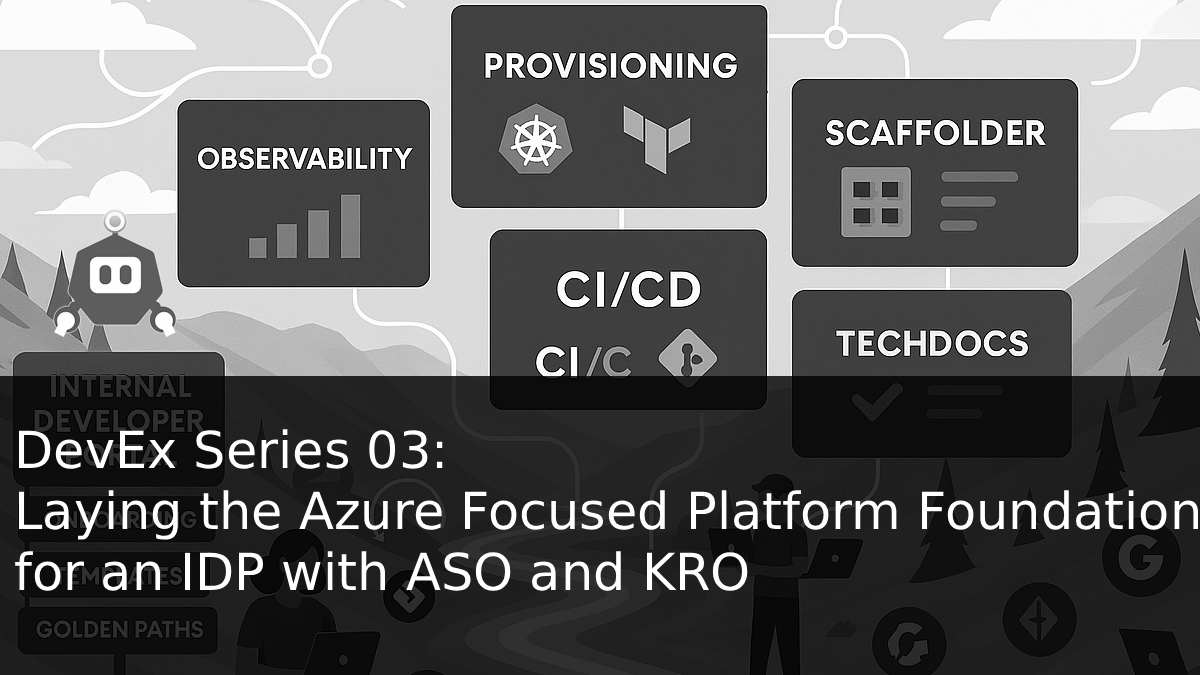
DevEx Series 03: Laying the Azure Focused Platform Foundation for an IDP with ASO and KRO
In the first two parts of this DevEx series, I tried to show how golden paths in Backstage can enable developer self‑service without chaos and how extending the catalog into copilots with MCP servers transforms discoverability into a conversational experience. Both of these steps were about reducing friction and giving developers paved roads to move […]
Read More
Securing the Supply Chain of Containerized Applications to Reduce Security Risks (Policy Enforcement-Automated Governance with OPA Gatekeeper and Ratify) – Part 2
In the first part of the article, we talked the importance of Software Supply Chain security and the measures that can be taken throughout the SDLC processes to mitigate the security risks of containerized applications. In this context, we emphasized the importance of the shifting-left approach, highlighting the benefits of integrating various security elements into […]
Read More
Securing the Supply Chain of Containerized Applications to Reduce Security Risks (Security Scanning, SBOMs, Signing&Verifying Artifacts) – Part 1
As we know, the adoption of containerization in modern software development environments has significantly changed the way applications are built and deployed. The lightweight and self-contained nature of containers provides various advantages and flexibilities, such as the ability to easily move applications consistently across different environments and quickly scale them. In addition, containers are also […]
Read More
Building Microservices by Using Dapr and .NET with Minimum Effort – 02 (Azure Container Apps)
In the previous article, we talked about the Dapr project, its benefits and developed two sample microservice with .NET 6 as self-hosted mode in the local environment. (If you haven’t read the first article, you can find it here.) Within the scope of this article, we will perform the deployments on Azure Container Apps by […]
Read More
Some Awesome News of .NET 7
As we know, .NET Conf 2022 took place between 8-10 November. During the conf, exciting news and performance improvements around .NET 7 and C# 11 were mentioned. In this release, especially some topics got focused which support us to develop more “fast”, “lightweight” and easier “cloud-native” applications. In this article, I will try to mention […]
Read More
Building Microservices by Using Dapr and .NET with Minimum Effort – 01
As we know, technology and our habits are constantly changing day by day. Especially after the pandemic, the trend towards digitalization and technology has increased considerably. Due to these changes, we as developers, also pay attention that the applications we develop are portable and scalable as much as possible in order to adapt to these […]
Read More
Getting Memory Dump of .NET Applications (Windows&Linux Containers) on Kubernetes
As we know, the best way to debug our applications that crash or hang due to memory leaks or unknown reasons is to analyze the dump files. At least that’s how my experience has been so far. As developers, at least we need to be able to analyze dumps to roughly understand why our applications […]
Read More
Working with Persistent Volumes by Using Azure Files in Azure Kubernetes Service
Applications that we develop as cloud-native sometimes may have to deal with data related operations such as accessing, storing or sharing a data between applications. As we know, our applications that we host on Kubernetes as containerized are ephemeral and stateless by nature. In other words, if we don’t use a persistent storage solution, any […]
Read More
Performing SQL Migration Operations by using Kubernetes Job
As technology is constantly evolving and changing, the database schema of the application, that we work in, can also change with each new feature we implement. Therefore, we need to follow a migration strategy. In this way, the changes, that will be performed on domain models, can also be applied to the database schema. In […]
Read More
Useful Information for Windows Containers
As we can imagine, trying to migrate existing applications to the cloud environment with the lift & shift approach due to time and cost reasons, is sometimes not as easy as we think. Especially if we want to host and manage the existing applications, that we have developed with .NET Framework, as containerized in environments […]
Read More
Securing Microservice Communication with Istio
As we can imagine, the technology and needs are rapidly evolving and growing day by day. Because of these rapid changes, organizations are also trying to renew their technology in order to keep themselves up to date. So, the general approach is focused on the microservice architecture to scale both business/organization and technology. Also as […]
Read More
Kubernetes for Production: Some Useful Information
As we know, in recent years kubernetes has become an essential standard on container orchestration topic for our microservice architectures. Although kubernetes solves many of our problems with its default usage, there are also some best practices and applications available that we can use to make our applications more stable, reliable and secure. I have […]
Read More
Using Internal Nginx Ingress with Azure Kubernetes Service
As we know, we need an ingress controller in Kubernetes to route traffic through a single IP address and for TLS termination operations. Although various Service Mesh technologies are preferred for these types of operations, in some cases we need an ingress controller like Nginx depending on the type and size of the system. For […]
Read More
Migrate Existing .NET Applications to Azure Kubernetes Service
In today’s technology era, we all know how important it is to host applications in the cloud environment especially for large-scale companies. According to many survey data, both public and private cloud usage ratio have increased considerably, especially in the last two years. There are several main reasons to transition to the cloud, some of […]
Read More
Understanding SOLID Principles, keep calm! For Cloud-Native Applications
In this article, I want to mention about the SOLID principles but this time for cloud-native applications. As we know, SOLID principles are undoubtedly one of the most important sets of principles in the object-oriented software development world. We are generally trying to develop our codes based on the SOLID principles when we develop applications, […]
Read More
Playing with Service Mesh – Linkerd and Azure Kubernetes Service
As we know, Microsoft launched many innovations this year at Barcelona KubeCon. I think one of the great was SMI(Service Mesh Interface). As far as I understand, I can say that for the definition of SMI, it provides “interoperability” topic between service meshes just as AMQP. In essence, it offers a standard interface for service […]
Read More