 Based in Netherlands

Gökhan Gökalp
Cloud Architecture, Platform Engineering & Agentic AI
© Thoughts, opinions, and lessons learned from building software systems.
Contact Blog PostsTag
kubernetes
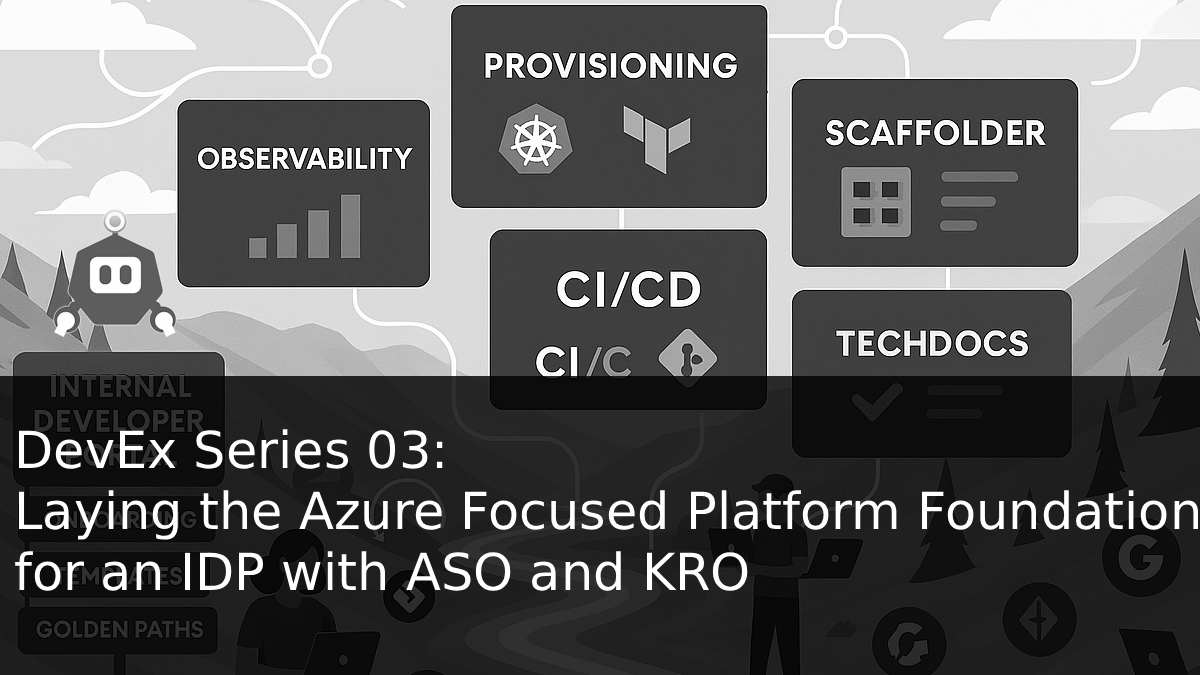
DevEx Series 03: Laying the Azure Focused Platform Foundation for an IDP with ASO and KRO
In the first two parts of this DevEx series, I tried to show how golden paths in Backstage can enable developer self‑service without chaos and how extending the catalog into copilots with MCP servers transforms discoverability into a conversational experience. Both of these steps were about reducing friction and giving developers paved roads to move […]
Read More
Securing the Supply Chain of Containerized Applications to Reduce Security Risks (Security Scanning, SBOMs, Signing&Verifying Artifacts) – Part 1
As we know, the adoption of containerization in modern software development environments has significantly changed the way applications are built and deployed. The lightweight and self-contained nature of containers provides various advantages and flexibilities, such as the ability to easily move applications consistently across different environments and quickly scale them. In addition, containers are also […]
Read More
Working with Persistent Volumes by Using Azure Files in Azure Kubernetes Service
Applications that we develop as cloud-native sometimes may have to deal with data related operations such as accessing, storing or sharing a data between applications. As we know, our applications that we host on Kubernetes as containerized are ephemeral and stateless by nature. In other words, if we don’t use a persistent storage solution, any […]
Read More
Performing SQL Migration Operations by using Kubernetes Job
As technology is constantly evolving and changing, the database schema of the application, that we work in, can also change with each new feature we implement. Therefore, we need to follow a migration strategy. In this way, the changes, that will be performed on domain models, can also be applied to the database schema. In […]
Read More
Useful Information for Windows Containers
As we can imagine, trying to migrate existing applications to the cloud environment with the lift & shift approach due to time and cost reasons, is sometimes not as easy as we think. Especially if we want to host and manage the existing applications, that we have developed with .NET Framework, as containerized in environments […]
Read More
Securing Microservice Communication with Istio
As we can imagine, the technology and needs are rapidly evolving and growing day by day. Because of these rapid changes, organizations are also trying to renew their technology in order to keep themselves up to date. So, the general approach is focused on the microservice architecture to scale both business/organization and technology. Also as […]
Read More
Kubernetes for Production: Some Useful Information
As we know, in recent years kubernetes has become an essential standard on container orchestration topic for our microservice architectures. Although kubernetes solves many of our problems with its default usage, there are also some best practices and applications available that we can use to make our applications more stable, reliable and secure. I have […]
Read More
Using Internal Nginx Ingress with Azure Kubernetes Service
As we know, we need an ingress controller in Kubernetes to route traffic through a single IP address and for TLS termination operations. Although various Service Mesh technologies are preferred for these types of operations, in some cases we need an ingress controller like Nginx depending on the type and size of the system. For […]
Read More
Migrate Existing .NET Applications to Azure Kubernetes Service
In today’s technology era, we all know how important it is to host applications in the cloud environment especially for large-scale companies. According to many survey data, both public and private cloud usage ratio have increased considerably, especially in the last two years. There are several main reasons to transition to the cloud, some of […]
Read More
Playing with Service Mesh – Linkerd and Azure Kubernetes Service
As we know, Microsoft launched many innovations this year at Barcelona KubeCon. I think one of the great was SMI(Service Mesh Interface). As far as I understand, I can say that for the definition of SMI, it provides “interoperability” topic between service meshes just as AMQP. In essence, it offers a standard interface for service […]
Read More
Kubernetes-based Event Driven Autoscaling with KEDA, RabbitMQ and .NET Core
As you know, these days Microsoft is making a lot of leaps and investments for the open-source world. One of these leaps is a component called KEDA, which is developing in a partnership with Red Hat and it enables us to performs Kubernetes-based Event Driven Autoscaling. Since the announcement of KEDA, I have started to […]
Read More
Logging API Requests and Responses to GrayLog over Azure API Management using Azure Functions
As you know, one of the most basic features that nearly every backend application must have is logging of requests and responses. Especially in environments where multi API usage is concerned, it is a basic feature that switches from “nice-to-have” state to “must-have” state. Because, there may be a time, that we need to be […]
Read More
ASP.NET Core Series 03: Containerizing a RESTful API and Deploying to Kubernetes Using Azure Container Service
Hi, all! We have developed a RESTful API in the previous ASP.NET Core blog post series, and then we deployed that to the Azure App Services. In this blog post series, I’ll try to mention how we can containerize a RESTful API, and then how we can deploy it to Kubernetes using Azure Container Service, based my experience in […]
Read More